


Résumé
Pour personnaliser efficacement le contenu de la formation au leadership, les organisations ont besoin de plus que du matériel de marque ou des exemples générés par l’IA. Le développement du leadership le plus efficace combine l’apprentissage personnalisé, le contexte organisationnel et la conception pédagogique fondée sur des données probantes pour améliorer l’engagement, l’application et les performances de leadership.
Les organisations reconnaissent depuis longtemps que le développement du leadership est plus efficace lorsqu’il reflète le travail réel des leaders. Mais jusqu’à récemment, la personnalisation du contenu de la formation impliquait souvent de choisir entre une formation au leadership évolutive et prête à l’emploi ou des programmes personnalisés coûteux et chronophages.
Aujourd’hui, les progrès de l’IA et les nouvelles approches de développement de contenu facilitent plus que jamais la personnalisation du contenu de la formation en leadership. Les organisations peuvent désormais personnaliser l’apprentissage en quelques minutes plutôt qu’en plusieurs mois. Mais la vitesse seule ne crée pas un meilleur apprentissage. Le simple fait de demander à l’IA de générer une nouvelle étude de cas ou d’échanger des noms d’entreprise dans des documents existants ne rend pas le développement du leadership plus efficace.
La grande question est la suivante : comment personnaliser la formation en leadership sans sacrifier la science du leadership et la conception pédagogique qui la rendent efficace ?
La véritable personnalisation va au-delà des changements au niveau de la surface. Il crée des expériences d’apprentissage qui sont pertinentes pour les leaders individuels, reflètent le contexte unique de l’organisation et sont fondées sur des recherches sur le leadership fondées sur des données probantes et une conception pédagogique éprouvée.
Une personnalisation significative combine trois éléments essentiels : un apprentissage personnalisé qui reflète les leaders individuels, un contexte organisationnel qui reflète les réalités de l’entreprise et une conception pédagogique fondée sur des données probantes qui entraîne un changement de comportement durable.
Pourquoi la pertinence est-elle plus importante que jamais dans le développement du leadership ?
Les principes fondamentaux du leadership n’ont pas changé. Les grands leaders doivent toujours communiquer efficacement, encadrer les employés, instaurer la confiance, prendre des décisions judicieuses et diriger le changement. Ce qui a changé, c’est l’environnement dans lequel ces compétences sont appliquées. Les leaders d’aujourd’hui sont confrontés à une plus grande complexité, à des priorités concurrentes et à des changements organisationnels constants, ce qui rend plus difficile de consacrer du temps à leur propre développement.
Selon les prévisions mondiales en matière de leadership de DDI, seuls 30 % des dirigeants déclarent disposer de suffisamment de temps pour s’acquitter efficacement de leurs responsabilités de leadership. Dans le même temps, 71 % d’entre eux font état d’une augmentation du stress depuis qu’ils ont pris leurs fonctions de direction actuelles, et parmi ces leaders, 40 % ont envisagé d’abandonner complètement leurs rôles de direction. Lorsque les opportunités de développement sont limitées, chaque expérience d’apprentissage doit apporter une valeur immédiate.
Souvent, les scénarios génériques ne trouvent pas d’écho parce qu’ils ne reflètent pas les situations auxquelles les leaders sont confrontés tous les jours. Un responsable de l’industrie manufacturière qui gère des interruptions de production, un responsable du secteur de la santé qui fait face à des pénuries de personnel et un directeur des ventes qui accompagne un chargé de compte peu performant peuvent tous acquérir la même compétence de coaching, mais les conversations qu’ils ont, les décisions qu’ils prennent et les pressions auxquelles ils sont confrontés sont très différentes.
C’est pourquoi une personnalisation efficace se concentre sur le contexte autant que sur le contenu. Bien que le comportement de leadership sous-jacent reste cohérent, la façon dont les leaders l’appliquent varie en fonction de leur rôle, de leur secteur d’activité et de leur environnement commercial. Lorsque les expériences d’apprentissage reflètent ces réalités, les leaders peuvent rapidement reconnaître comment les concepts s’appliquent à leur propre travail, ce qui facilite la compréhension, la pratique et l’utilisation de nouveaux comportements au travail.
Les organisations ne sont pas simplement à la recherche d’une formation personnalisée ; Ils sont à la recherche d’expériences d’apprentissage qui aident les leaders à être plus efficaces dans les moments qui comptent le plus. Cela commence par la compréhension de ce à quoi ressemble réellement une personnalisation significative.
Qu’est-ce que cela signifie concrètement de personnaliser le contenu d’une formation en leadership ?
Demandez à dix organisations ce que signifie une formation personnalisée en leadership, et beaucoup d’entre elles vous décriront des changements cosmétiques :
- Ajout du logo de l’entreprise
- Mise à jour des couleurs et de l’image de marque
- Remplacement d’un nom d’entreprise dans les documents des participants
- Révision de quelques exemples ou de la terminologie
Ces mises à jour ont certainement de la valeur. Ils créent une familiarité, renforcent l’appropriation organisationnelle et aident les apprenants à reconnaître que la formation a été conçue pour leur entreprise. Cependant, ils ne modifient pas fondamentalement l’expérience d’apprentissage et ne la rendent pas plus pertinente pour le travail quotidien des dirigeants.
Une personnalisation significative va beaucoup plus loin. Cela oblige les organisations à tenir compte non seulement des personnes qui apprennent, mais aussi de l’environnement dans lequel elles travaillent et de la façon dont les gens apprennent le plus efficacement. Les trois couches suivantes fournissent un cadre pour créer un développement du leadership plus pertinent, engageant et susceptible d’entraîner un changement de comportement durable.
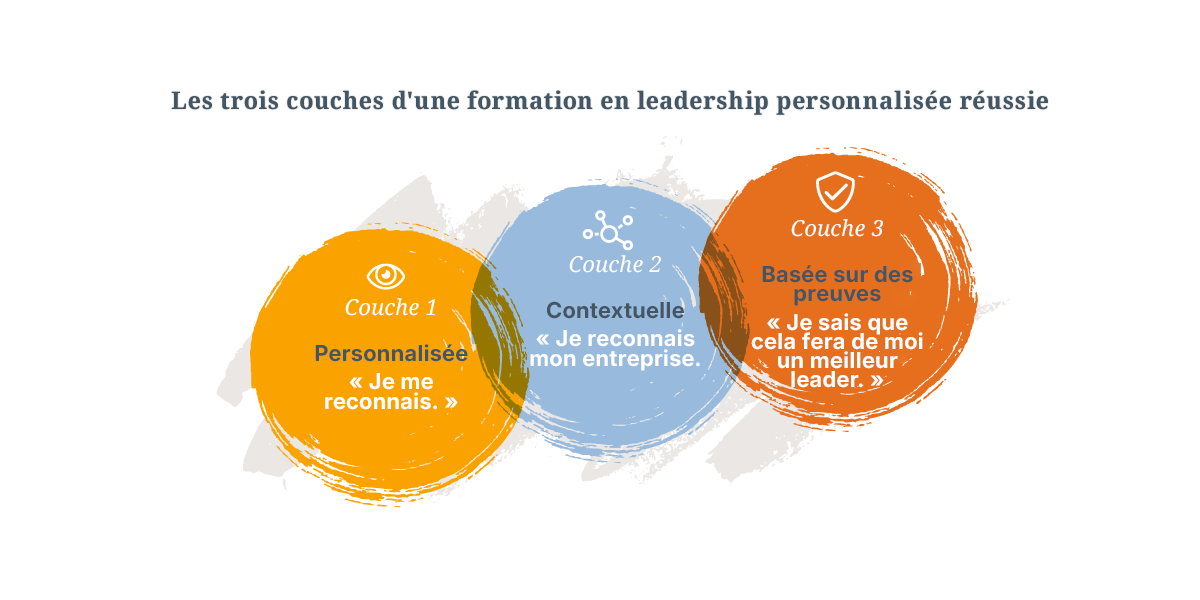
Couche 1 : Rendre le contenu pertinent pour l’apprenant
La première couche d’une personnalisation efficace commence par le leader individuel. Tous les leaders n’ont pas besoin des mêmes exemples, activités ou parcours d’apprentissage, car les responsabilités en matière de leadership varient considérablement selon les rôles, les niveaux d’expérience et les contextes commerciaux. Un superviseur de première ligne nouvellement promu est confronté à des défis différents de ceux d’un vice-président qui dirige la transformation organisationnelle, et son développement doit refléter ces différences.
Un contenu d’apprentissage personnalisé de haute qualité tient compte de facteurs tels que :
- Niveau de leadership (première ligne, niveau intermédiaire, cadre supérieur, cadre)
- Rôle et fonction
- Responsabilités actuelles en matière de leadership
- Lacunes en matière de compétences identifiées dans le cadre d’évaluations
- Expérience antérieure en leadership
- Priorités immédiates de développement
- Les défis que les leaders tentent de relever aujourd’hui
Les évaluations peuvent jouer un rôle important dans l’identification objective de ces besoins plutôt que de s’appuyer sur des hypothèses. Au lieu d’attribuer à chaque leader le même programme, les organisations peuvent utiliser les données d’évaluation pour hiérarchiser les capacités qui auront le plus grand impact pour chaque apprenant.
Envisagez un atelier sur les compétences en coaching. Bien que le comportement de base du leadership, à savoir tenir une conversation de coaching efficace, reste le même, les situations rencontrées par les leaders doivent refléter les réalités de leurs rôles. Un superviseur débutant peut avoir besoin de relever des défis liés à l’assiduité ou à l’intégration, tandis qu’un directeur d’usine de fabrication peut encadrer un employé expérimenté pour résoudre les problèmes de sécurité récurrents sans compromettre la productivité. Un directeur de district de vente au détail peut se concentrer sur l’amélioration de l’expérience client sur plusieurs sites, un responsable des soins de santé peut gérer des conversations de coaching au sein d’équipes de soins interfonctionnelles pendant les pénuries de personnel, et un directeur des ventes peut encadrer un employé très performant dont les résultats ont diminué en raison de l’évolution des conditions du marché.
Lorsque les leaders reconnaissent leurs propres expériences dans des scénarios, des discussions et des activités pratiques, il est plus facile de comprendre comment les nouveaux concepts s’appliquent à leur travail et de renforcer la confiance en utilisant ces comportements au travail. Cette pertinence augmente également la motivation en aidant les leaders à voir la valeur immédiate de ce qu’ils apprennent.
Couche 2 : Rendre le contenu contextuel pour l’organisation
La personnalisation aide les leaders à se reconnaître dans l’expérience d’apprentissage, mais un développement efficace du leadership doit également refléter l’organisation dans laquelle ils travaillent.
De nombreuses organisations commencent par ajouter leur logo, mettre à jour les couleurs ou remplacer les noms génériques des entreprises par les leurs. Ces changements créent une familiarité et renforcent l’appropriation du programme, mais une personnalisation significative va beaucoup plus loin en intégrant le langage, les priorités et les réalités commerciales de l’organisation tout au long de l’expérience d’apprentissage.
Selon les besoins de l’organisation, la personnalisation peut inclure des éléments tels que :
- L’image de marque d’une entreprise
- Les valeurs et les attentes d’une entreprise en matière de leadership
- Terminologie interne et cadrage spécifique à l’industrie
- Les priorités stratégiques, les objectifs commerciaux et les initiatives d’une entreprise
- La culture et les méthodes de travail d’une entreprise
Ces éléments aident les leaders à associer de nouvelles compétences aux décisions qu’ils prennent chaque jour. Par exemple, un cours sur la gestion des conflits peut utiliser un scénario générique impliquant deux employés en désaccord sur les responsabilités du projet. Bien qu’il s’agisse d’un défi courant en matière de leadership, il se peut qu’il ne reflète pas les situations dans lesquelles les dirigeants sont réellement confrontés au sein de leur propre organisation.
Le même comportement de leadership devient beaucoup plus pertinent lorsqu’il est présenté dans des situations professionnelles familières. Les responsables de l’industrie manufacturière peuvent s’entraîner à résoudre les désaccords sur les retards de production qu’ils subissent réellement sur la ligne tout en équilibrant les objectifs de sécurité, de qualité et d’exploitation. Les leaders du secteur de la santé pourraient s’entraîner à travailler sur des conflits authentiques que vivent les équipes cliniques lorsqu’elles gèrent les soins aux patients pendant les pénuries de personnel. En revanche, les leaders du commerce de détail peuvent s’entraîner à gérer les escalades de clients réelles lors de scénarios de demande saisonnière spécifiques. Les responsables technologiques, quant à eux, peuvent se concentrer sur la facilitation des conversations entre les équipes hybrides travaillant sur des priorités concurrentes en matière de lancement de produits.
En ancrant l’apprentissage dans des situations professionnelles familières, il est plus facile pour les leaders de reconnaître où et comment appliquer de nouvelles compétences au sein de leur propre organisation.
Le contexte organisationnel évolue beaucoup plus rapidement que les programmes d’apprentissage traditionnels. Un cours de leadership développé il y a quelques années à peine peut ne plus refléter les priorités stratégiques, les conditions du marché ou les défis de main-d’œuvre d’aujourd’hui. L’examen et la mise à jour réguliers d’exemples, de scénarios et d’activités permettent de s’assurer que l’apprentissage reste aligné sur les besoins de l’entreprise et permettent aux leaders d’appliquer immédiatement les nouveaux concepts.
La personnalisation et la pertinence organisationnelle créent une expérience d’apprentissage plus forte, mais elles ne sont qu’une partie de l’équation. Pour favoriser un changement de comportement durable, le développement du leadership doit également être fondé sur une science du leadership et une conception pédagogique éprouvées.
Couche 3 : Contenu de base en science du leadership et conception pédagogique éprouvée
La personnalisation doit rendre le développement du leadership plus pertinent sans compromettre sa qualité. Alors que les organisations recherchent des moyens plus rapides de personnaliser l’apprentissage, il est facile de se concentrer sur la création de plus de contenu. Mais un développement efficace du leadership ne se mesure pas au nombre de scénarios, de vidéos ou d’activités qu’il contient. Il est mesuré par la capacité des leaders à développer de nouveaux comportements et à les appliquer avec succès au travail.
Pour atteindre ce résultat, il faut deux fondements essentiels : la science du leadership et la conception pédagogique.
- Ancre l’apprentissage dans la recherche validée plutôt que dans l’opinion populaire ou les tendances de gestion
- Donne aux apprenants l’assurance qu’ils développent des comportements éprouvés pour améliorer l’efficacité du leadership
Conception pédagogique :
- Applique des principes d’apprentissage éprouvés pour aider les leaders à comprendre, pratiquer, retenir et appliquer de nouveaux concepts
- Donne la priorité aux actions clés ayant le plus d’impact plutôt que de simplement couvrir plus de contenu
Ces bases sont devenues encore plus importantes à mesure que l’IA transforme la façon dont les organisations créent du contenu d’apprentissage. L’IA générative peut rapidement produire des scénarios, des questions de discussion et des supports d’apprentissage, ce qui rend la personnalisation plus rapide et plus évolutive que jamais.
Mais l’IA ne peut pas prendre les décisions de conception pédagogique qui déterminent si l’apprentissage conduit à un changement de comportement. Il ne peut pas déterminer quels comportements méritent la plus grande attention, comment l’apprentissage doit être séquencé ou quand les leaders ont besoin d’occasions de pratiquer et de recevoir du feedback.
Considérez la différence dans la pratique : un leader qui ne dispose que de 30 minutes pour le développement. Un outil d’IA générative peut créer une leçon couvrant six comportements de communication différents, car il peut synthétiser rapidement des informations. Un concepteur pédagogique, s’appuyant sur la science du leadership et les principes d’apprentissage fondés sur des données probantes, identifierait plutôt le comportement le plus susceptible d’améliorer les performances dans ce laps de temps limité et concevrait l’expérience en aidant l’apprenant à le comprendre, à le pratiquer et à l’appliquer.
La valeur ne consiste pas simplement à générer du contenu plus rapidement. La valeur provient de l’utilisation de l’IA pour étendre la personnalisation tout en préservant la science du leadership et la conception pédagogique qui rendent l’apprentissage efficace. Lorsque les organisations combinent la recherche sur le leadership, une conception pédagogique éprouvée et une efficacité basée sur l’IA, elles ne se contentent pas de créer un contenu plus personnalisé. Ils créent des expériences d’apprentissage auxquelles les leaders peuvent faire confiance.
L’IA peut accélérer la personnalisation, mais elle ne peut pas remplacer l’expertise en matière d’apprentissage
L’intelligence artificielle facilite et accélère la création et la personnalisation du développement du leadership. Les tâches qui nécessitaient auparavant des semaines ou des mois, telles que la mise à jour des supports d’apprentissage, la personnalisation de l’apprentissage pour différents publics, la réponse à l’évolution des priorités de l’entreprise et la mise à l’échelle de la personnalisation à l’échelle de l’entreprise, peuvent désormais être effectuées beaucoup plus rapidement.
Ces fonctionnalités rendent la personnalisation plus rapide et plus accessible. Lorsqu’elle est guidée par l’expertise du leadership, l’IA peut aider les organisations à mettre à jour les supports d’apprentissage, à personnaliser le contenu pour différents publics et à répondre plus rapidement à l’évolution des besoins de l’entreprise sans sacrifier la qualité. Plutôt que de remplacer l’expertise pédagogique, l’IA permet aux organisations de l’appliquer plus efficacement. La recherche sur le leadership, la conception pédagogique et le contexte organisationnel doivent guider ce que l’IA crée, et non l’inverse.
Les organisations n’ont pas non plus besoin de repenser chaque programme de leadership à partir de zéro. Dans de nombreux cas, des mises à jour ciblées de scénarios, d’exemples et d’activités d’apprentissage peuvent rendre le contenu existant beaucoup plus pertinent tout en préservant la force d’un programme d’études éprouvé. L’IA peut aider à accélérer ces mises à jour, ce qui permet aux organisations de maintenir l’apprentissage en phase avec l’évolution des priorités de l’entreprise sans avoir à recommencer à zéro.
Cinq façons pratiques de personnaliser la formation en leadership sans partir de zéro
La personnalisation de la formation au leadership ne nécessite pas toujours la refonte d’un programme d’études complet. Dans de nombreux cas, de petites mises à jour intentionnelles peuvent rendre l’apprentissage plus pertinent tout en préservant la qualité du contenu existant. Voici cinq façons pratiques de commencer :

Commencez par les bonnes priorités.
Commencez par identifier les défis commerciaux que les leaders sont censés relever, puis hiérarchisez les comportements de leadership qui auront le plus grand impact. L’alignement du développement sur les priorités de l’entreprise permet de s’assurer que la personnalisation soutient à la fois les objectifs de l’entreprise et les performances individuelles.

Mettez à jour les exemples.
Les compétences en leadership restent constantes, mais les défis de l’entreprise évoluent. Actualisez régulièrement les scénarios, les études de cas et les activités pratiques afin qu’ils reflètent les initiatives stratégiques actuelles, les réalités de la main-d’œuvre et les attentes des clients.

Intégrez l’identité de votre organisation.
Intégrez la terminologie, les attentes en matière de leadership, les valeurs et la voix de la marque de votre organisation dans les supports d’apprentissage, non seulement dans l’introduction, mais aussi dans les scénarios, les incitations à la discussion et les activités pratiques. Ces détails aident les leaders à reconnaître que le contenu a été conçu pour soutenir leur façon de travailler et de diriger.

Personnalisez l’apprenant.
Tous les leaders n’ont pas besoin de la même expérience en matière de développement. Utilisez les résultats de l’évaluation, le niveau de leadership, le rôle ou les priorités de développement pour adapter l’apprentissage afin que les leaders se concentrent sur les compétences qui auront le plus grand impact.

Maintenez le contenu à jour au fil du temps.
Le développement du leadership doit évoluer en même temps que l’entreprise. Passez régulièrement en revue les programmes existants pour vous assurer que les exemples, les activités et les scénarios reflètent toujours les priorités actuelles de l’entreprise, les changements organisationnels et les défis auxquels les leaders sont confrontés aujourd’hui.
Une personnalisation significative est un processus continu plutôt qu’un projet ponctuel. En effectuant des mises à jour ciblées au fil du temps, les organisations peuvent faire en sorte que le développement du leadership reste pertinent, pratique et efficace sans avoir à reconstruire chaque programme à partir de zéro.
L’avenir de la formation au leadership est personnalisé, contextuel et évolutif
Jusqu’à récemment, les organisations étaient confrontées à des arbitrages difficiles. Ils pouvaient choisir une formation en leadership évolutive qui manquait de pertinence ou investir dans des programmes hautement personnalisés qui nécessitaient des mois de développement. Aujourd’hui, les organisations n’ont plus à choisir entre la rapidité, la pertinence et la qualité de l’enseignement, car l’IA a considérablement réduit ce compromis. Cependant, l’IA ne peut offrir une personnalisation efficace que si elle est guidée par la science du leadership et l’expertise pédagogique.
C’est l’opportunité qui se cache derrière une nouvelle génération de solutions, y compris CoLab Studio de DDI, qui combine l’efficacité basée sur l’IA avec des décennies de recherche sur le leadership et d’expertise en conception pédagogique pour aider les organisations à personnaliser le contenu de la formation en leadership tout en préservant la qualité et l’intégrité de l’expérience d’apprentissage.
En fin de compte, une personnalisation efficace ne consiste pas à créer plus de contenu, mais à créer des expériences d’apprentissage qui reflètent l’apprenant, l’organisation et la science de la façon dont les gens apprennent. Lorsque ces trois éléments fonctionnent ensemble, les organisations peuvent aider les leaders à apprendre plus rapidement, à appliquer leurs compétences en toute confiance et à être performants lorsque cela compte le plus.
Découvrez comment DDI CoLab Studio aide les organisations à personnaliser le contenu de la formation au leadership avec une efficacité basée sur l’IA tout en préservant la science du leadership et la conception pédagogique qui entraînent un changement de comportement durable.
Vous avez une question ?
Foire aux questions sur la personnalisation du contenu de la formation en leadership
-
Qu’est-ce que cela signifie de personnaliser le contenu d’une formation en leadership ?

Personnaliser le contenu de la formation en leadership signifie adapter l’apprentissage pour refléter les besoins de chaque leader, les priorités de l’organisation et les réalités de l’entreprise. Une personnalisation efficace va au-delà des logos et de l’image de marque en intégrant des scénarios pertinents, un apprentissage personnalisé et une conception pédagogique fondée sur des données probantes qui aide les leaders à appliquer de nouvelles compétences au travail.
-
L’IA peut-elle personnaliser le contenu de la formation au leadership ?
Oui. L’IA peut accélérer la personnalisation en mettant à jour les supports d’apprentissage, en créant des scénarios personnalisés et en adaptant le contenu à différents publics. Cependant, le développement du leadership le plus efficace combine l’IA avec la recherche sur le leadership, l’expertise en matière de conception pédagogique et le contexte organisationnel pour garantir que l’apprentissage est à la fois pertinent et efficace.
-
Quelle est la différence entre une formation en leadership de marque et une formation en leadership personnalisée ?
La formation au leadership de marque comprend des éléments visuels tels que les logos, les couleurs et la terminologie de l’entreprise. La formation personnalisée au leadership va plus loin en intégrant les priorités organisationnelles, les défis commerciaux, les scénarios spécifiques à l’industrie et les expériences d’apprentissage personnalisées qui aident les leaders à appliquer de nouvelles compétences dans leur travail quotidien.
-
Comment personnalisez-vous la formation en leadership pour différents niveaux de leadership ?
Les organisations peuvent personnaliser la formation en leadership en tenant compte de facteurs tels que le niveau de leadership, le rôle, l’expérience, les priorités de développement et les résultats des évaluations. En adaptant des exemples, des scénarios et des activités d’apprentissage, vous vous assurez que le contenu reflète les défis que les leaders sont les plus susceptibles de rencontrer dans leurs rôles spécifiques.
-
La personnalisation de la formation en leadership réduit-elle sa qualité ou son intégrité pédagogique ?
Non. Lorsqu’elle s’appuie sur des recherches sur le leadership fondées sur des données probantes et sur une conception pédagogique éprouvée, la personnalisation renforce l’apprentissage sans compromettre la qualité. L’IA et d’autres technologies peuvent rendre la personnalisation plus efficace, mais l’expertise en leadership et une conception pédagogique solide restent essentielles pour créer des expériences d’apprentissage qui favorisent un changement de comportement.
Sujets abordés dans ce blog