


Résumé
Investing in leadership development helps organizations improve business performance, retain talent, and prepare leaders for change. But maximizing that investment requires more than purchasing training content. Leadership training costs depend on the number of leaders, their development needs, delivery methods, and ongoing support. Organizations can make smarter investments by prioritizing the capabilities and experiences that drive measurable behavior change.
When budgets tighten, leadership development can become an easy target for cost-cutting. Yet the challenges driving those budget decisions, from increasing operational efficiency to managing organizational change, are the very challenges that require skilled leaders.
Without leaders setting strategic direction, operationalizing decisions, and energizing the workforce, successful transformation isn't possible. Alors, pourquoi investir dans le développement du leadership ?
According to DDI's Global Leadership Forecast 2027, only 17% of leaders feel very prepared to anticipate and react to change. As AI reshapes work, responsibilities expand, and business priorities shift, organizations can't afford to wait until leaders are struggling to give them the skills they need.
But investing in a leadership development program doesn't simply mean spending more on training. It means understanding which capabilities your business needs, what it costs to build them, and how to ensure development translates into better performance.
What Should a Leadership Development Investment Include?
Before determining how much to invest in leadership development, consider what that investment needs to accomplish. The most effective programs combine learning experiences with the insights, practice, and support leaders need to change their behavior.
Look for these characteristics when evaluating leadership development programs:
- C’est plus qu’un atelier : Le développement du leadership n’est pas « unique ». Done right, it is a journey of learning experiences that helps leaders grow continuously over time. It combines macro and micro learning to build skills and engage your leaders.
- It meets leaders in their time of need: Your program needs to be highly relevant and address the challenges your leaders face right now. Leadership development is most effective when people get the right development for the right moment. Qu’il s’agisse d’avoir une conversation difficile avec un membre de l’équipe ou de changer de rôle, les leaders ont besoin de développement pour les aider à faire face à ce à quoi ils sont confrontés sur le moment.
- It’s set up to work the way your people work: Choose delivery methods that fit your workforce, whether leaders work on-site, remotely, or across multiple locations and shifts. Virtual instructor-led learning, for example, can provide opportunities for discussion, collaboration, and skill practice without the expense of travel.
- It considers how your leaders like to learn: Give your leaders the training types they prefer most. Balance learning preferences with the methods that are most effective for building the required skills, including facilitated learning, self-directed resources, and on-the-job assignments.
- It has proven impact: During the planning phases of your program, consider how you will measure the impact of your leadership development program and prove ROI.
- Il laisse du temps pour la pratique : Un programme de leadership efficace va au-delà de la théorie. Ensure there is plenty of time to practice skills in a safe space with peers and on the job. Build in opportunities for leaders to receive feedback, refine their approach, and apply skills to real business challenges.
- It’s personalized: Give leaders access to leadership assessments that highlight their strengths and development needs. Use those insights to direct development resources toward the capabilities that will have the greatest impact.
When evaluating leadership development programs, look beyond the content and consider how each component contributes to lasting behavior change. What your program includes and how those elements work together will help determine both the cost and the value of your investment
What Determines Leadership Training Cost?
Leadership training costs vary based on the program's scope, the population being developed, and the level of support leaders need. A program designed to build foundational skills across hundreds of frontline leaders will require a different investment than one designed to prepare a small group of executives for critical strategic responsibilities.
The right leadership development investment will look different for every organization. Start by considering your business priorities, your leaders' capabilities, and the resources needed to close critical skill gaps.
When evaluating leadership development costs, consider these six factors and how each contributes to your investment's value:
| Cost Factor | What Influences the Investment | À prendre en compte |
| Number and level of leaders | The size of the learning population, number of cohorts, and complexity of leadership roles. | Determine which leadership populations have the most urgent development needs and where development can be scaled. |
| Program duration and scope | The number of skills, learning experiences, and length of the development journey. | Prioritize capabilities tied to business needs rather than trying to cover every possible leadership topic. |
| Learning delivery methods | In-person or virtual facilitation, digital learning, simulations, and blended learning experiences. | Balance accessibility and scalability with opportunities for meaningful practice and feedback. |
| Assessment and personalization | Diagnostic assessments, 360-degree feedback, and individualized development plans. | Direct development resources toward identified skill gaps instead of providing the same training to everyone. |
| Customization and implementation | Tailored content, integration with existing programs, facilitator preparation, and platform requirements. | Identify which elements need customization and where proven existing resources can meet your needs. |
| Reinforcement and measurement | Manager coaching, follow-up activities, skill application, and impact evaluation. | Budget for sustained behavior change, not just initial participation or course completion. |
Beyond direct program expenses, consider indirect costs such as leaders' time away from their responsibilities, internal administration, and travel. These expenses can significantly affect the total investment, so compare programs based on full cost rather than training price alone.
Where Should Organizations Invest Their Leadership Development Budget?
Not every development method delivers the same value. While digital content can help organizations reach more leaders at a lower cost per participant, access to content alone doesn't guarantee leaders will change their behavior.
DDI's HR Insights Report 2025 found that the percentage of organizations reporting strong ROI varied considerably by development method:
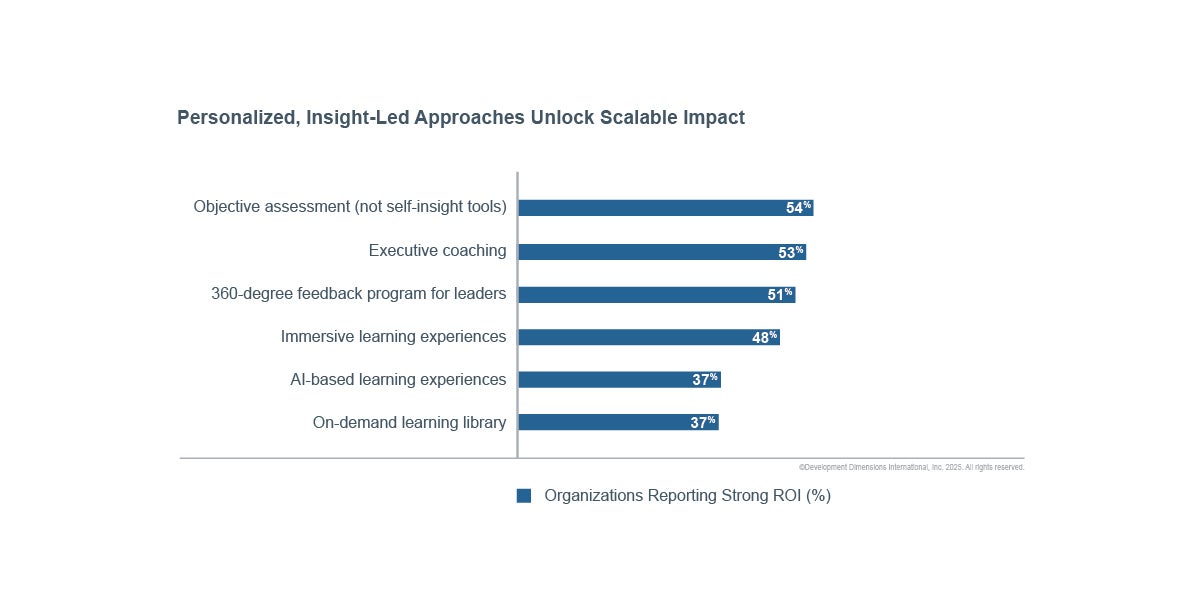
The research reinforces the value of development that begins with personal insight and gives leaders opportunities to practice, receive feedback, and improve. Scalable learning resources can be valuable components of this approach, especially when connected to specific development needs.
Rather than choosing between high-touch and scalable development, consider how different methods can work together. Combining diagnostic assessments, facilitated learning, digital resources, and coaching can help organizations extend their reach while staying focused on behavior change.
The Business Value of Investing in Leadership Development
The most important goal of leadership development is to change behavior. Leaders must identify their development needs and potential derailers. Ils doivent faire les choses différemment et développer de nouvelles compétences. Lorsque les comportements changent, des avantages commerciaux apparaissent. Valuable outcomes such as increased revenue, cultural change, or transformation start with leaders who have the skills to take the right actions.
With development, effective leadership behaviors increased by 77% among informal and emerging leaders, compared to 75% among frontline leaders, 56% among mid-level leaders, and 40% among senior leaders.
Companies that invest in their leaders are better positioned to strengthen business performance, reduce talent risks, and prepare for future challenges. These outcomes are important considerations when determining the value of a development investment.
Improving Business Performance
Simply put, companies with effective leadership development programs have higher-performing leaders and teams than their competitors. According to our research on leadership development ROI, HR leaders who rate their development programs as high quality are 2X more likely to report that development improved business performance.
Think about it: to stay competitive, leaders must move quickly, pivot, forecast, problem-solve, coach, communicate, delegate, and more. Les leaders qui ont perfectionné ces compétences donnent à leur entreprise un avantage concurrentiel clé, en particulier en période de turbulences.
Consider how organizations benefit from investing in leaders who have these capabilities:
- Leaders who are comfortable taking calculated risks.
- Leaders who are skilled at empowering their teams to try something different.
- Leaders with financial and business acumen to analyze complex situations and identify opportunities to improve business performance.
Leaders must not only adapt to change, but lead it. They must do the right things at the right moments in an increasingly complex, ever-changing global economy.
Attirer et retenir les talents
Employees want to work for organizations that invest in their professional growth. When people can see a path to advancement and have access to the development they need to get there, they have more reasons to stay. A well-established leadership development program is a selling point that can help your company attract and retain talent.
In addition, great leaders are upskilled in the interviewing skills necessary to provide an experience that makes candidates want to work for your organization.
Investing in behavioral interviewing skills helps managers make more informed hiring decisions while creating a positive candidate experience. La formation en leadership peut également être cruciale pour retenir les employés et maintenir un faible taux de roulement.
Valuable outcomes such as increased revenue, cultural change, or transformation start with leaders who have the skills to take the right actions.
DDI's research found that high-potential talent is 3.7X more likely to leave when they lack development opportunities. Losing these individuals can mean not only incurring recruitment and onboarding expenses but also losing potential successors for critical leadership roles.
What's more, when leaders have the skills to inspire, engage, and connect with their teams, employees are more likely to be engaged with each other and their role-and find purpose in their work. Teams that work effectively together also help build a culture of trust.
N’oubliez pas qu’il est souvent beaucoup moins coûteux de développer, d’encadrer et de promouvoir à l’interne que d’embaucher à l’externe. Investing in leadership development training upskills your talent for short- and long-term benefits.
When evaluating the cost of leadership development, consider what your organization is already spending on replacing talent, addressing performance issues, and recruiting externally for roles that could be filled internally. These costs provide important context for investment decisions.
Building a Stronger Leadership Pipeline
Quel est l’impact du développement du leadership sur votre entreprise à long terme ? Consider how quickly leadership requirements are evolving as organizations navigate AI adoption, restructuring, and changing business models. Leaders who are effective in their roles today may need an entirely different set of capabilities to succeed tomorrow.
DDI's research shows that organizations with high-quality leadership development programs can immediately fill approximately 39% more critical leadership roles with internal candidates than those with lower-quality programs.
By investing in development before leadership gaps become urgent, organizations can build a more reliable talent pipeline, reduce dependence on external hiring, and maintain continuity when key leaders leave or business priorities change.
How to Budget for Leadership Development
How much should an organization spend on leadership development? While there is no universal budget that works for every organization, underinvesting can limit the results development delivers. Spending more, however, doesn't automatically translate into better outcomes.
DDI's research found that only 47% of organizations investing below average in their high-potential leaders reported improved business performance, compared with more than 70% of those investing at or above average. Beyond average investment, performance outcomes tended to level off, reinforcing the importance of how development dollars are spent.
To build a leadership development budget that balances cost and impact, consider these six steps:
1. Start With Business Priorities
Identify the business challenges your organization needs leaders to address. Whether the priority is improving retention, accelerating AI adoption, increasing operational efficiency, or preparing successors, establish the leadership behaviors that will support those goals.
2. Identify Who Needs Development
Determine which leadership populations need development and how urgently. Consider emerging leaders, frontline managers, mid-level leaders, executives, and high-potential talent rather than limiting investment to one level of the organization.
3. Assess Leadership Strengths and Gaps
Use leadership assessments to establish a baseline and understand where leaders need to grow. These insights can help you avoid spending limited development dollars on capabilities leaders have already mastered.
4. Select the Right Development Methods
Choose learning methods based on the behaviors you want to develop. Combine scalable resources with facilitated learning, skill practice, coaching, and feedback where they will have the greatest impact.
5. Calculate the Total Investment
Account for more than the upfront price of leadership training. Include program design, content, technology, facilitation, assessment, customization, participant time, and ongoing reinforcement. When comparing providers, ask what the quoted price includes and what requires additional investment.
6. Define How You Will Measure Success
Agree on success measures with stakeholders before development begins. Track changes in leadership behavior alongside relevant team and business outcomes to demonstrate the value of your investment and inform future budgeting decisions.
By taking this approach, HR can build a leadership development budget around business needs rather than a predetermined number of training hours, courses, or participants. It also creates a stronger foundation for conversations with stakeholders about where development dollars will have the greatest impact.
Make Your Leadership Development Investment Count
Le développement du leadership bien fait a certainement un impact sur les organisations. Mais cela peut aussi changer la vie au niveau individuel.
We've heard countless stories from clients and associates over the years about how becoming a better leader has changed lives. Lors d’une récente conférence de l’industrie, un participant a partagé ce qu’il avait appris sur les compétences de base lors d’une formation en leadership il y a 15 ans. The attendee recited the five most important principles from that training and how they still use them regularly during interactions with friends, family, and colleagues. They said these skills made leadership and life easier.
That's what makes leadership development such a valuable investment. The skills leaders build can influence how they lead their teams, develop future talent, and deliver business results for years to come. And those capabilities stay with leaders long after a formal training program ends.
The right leadership development investment will look different for every organization. Start by considering your business priorities, your leaders' capabilities, and the resources needed to close critical skill gaps. If you're unsure where to begin or how to budget for development, connect with DDI to better understand your options and what an investment might look like for your organization.
Vous avez une question ?
Frequently Asked Questions About Investing in Leadership Development
-
Why should organizations invest in leadership development now rather than delay?

Organizations should invest in leadership development now to prepare leaders for evolving business demands, AI adoption, and ongoing change. With only 17% of leaders feeling very prepared to anticipate and react to change, delaying development can put business performance, employee engagement, and leadership readiness at risk.
-
How does investing in leadership development improve business performance?
Investing in leadership development helps leaders build the skills to make better decisions, improve productivity, drive operational efficiency, and execute business strategy. The greatest value comes from development that translates learning into measurable behavior change and aligns leadership capabilities with business priorities.
-
How can leadership development help organizations attract and retain talent?
Leadership development demonstrates an organization's commitment to professional growth while creating clearer pathways for career advancement. It also equips managers with the coaching, communication, and interpersonal skills needed to build trust, engage employees, and create a work environment where people want to stay.
-
What should organizations look for in an effective leadership development program?
Organizations should look for a program that aligns with business priorities, addresses individual skill gaps, and combines relevant learning experiences with realistic practice, coaching, and feedback. When evaluating leadership training costs, organizations should also consider whether the program includes ongoing reinforcement and tools to measure behavior change and business impact.
-
How does leadership development prepare organizations for change and future disruption?
Leadership development builds the adaptability, strategic thinking, decision-making, and interpersonal skills leaders need to navigate uncertainty and guide their teams through change. Proactively investing in these capabilities also strengthens the leadership pipeline, helping organizations maintain business continuity as priorities shift and new challenges emerge.